AI SEO
Best AI SEO Tools in 2026: Surfer SEO vs Writesonic & Workflow Fit

Choosing between Surfer SEO and Writesonic in 2026 is less about finding a single “best AI SEO tool” and more about matching the platform to the job you actually need done. Surfer is strongest when your priority is search-focused content optimization, briefs, audits, and structured on-page guidance. Writesonic is broader: it combines SEO workflows with AI article production, site audits, and AI-search visibility tracking across answer engines such as ChatGPT, Gemini, and Google AI Overviews.
This guide compares them by workflow, pricing model, team fit, AI-search visibility, content operations, and the amount of human review each still needs.
Surfer SEO vs Writesonic: quick comparison
| Area | Surfer SEO | Writesonic |
|---|---|---|
| Best fit | On-page SEO optimization, briefs, audits, content scoring | SEO + GEO, AI content production, AI visibility tracking |
| Core workflow | Optimize and improve existing or planned search content | Create, audit, monitor, and improve content across search and AI discovery |
| Entry pricing | Discovery from $49/month billed yearly | Starter from $79/month billed yearly |
| AI-search visibility | Available through Surfer’s newer AI visibility features | Central part of the product, with tracking across major AI platforms |
| Best for | SEO specialists, editors, content teams | Marketing teams combining SEO, content, and GEO workflows |
See the full Aiverio profiles for Surfer SEO, Writesonic, and our new Clearscope profile for a premium content-optimization and AI-visibility alternative.
1. Surfer SEO: best for structured on-page optimization
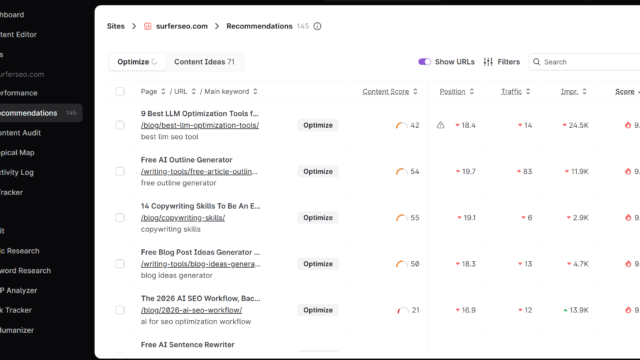
Surfer is built around helping teams create or improve pages using search-result patterns, semantic coverage, content guidelines, and audit workflows. Its value is clearest when a team already has writers or editors and wants a repeatable optimization process rather than an all-in-one marketing suite.
Where Surfer fits best
- Creating SEO briefs before an article is written
- Improving existing pages with structured optimization guidance
- Auditing content that has lost visibility or needs refresh work
- Giving editors a consistent framework for on-page optimization
- Managing repeatable SEO workflows across many pages
Surfer’s current pricing structure includes a Discovery plan from $49 per month when billed yearly, with higher plans for teams that need more documents, tracked pages, integrations, AI visibility, and larger usage limits. The product also offers a short free trial for new accounts.
Best for: teams that already have a content process and need stronger SEO optimization discipline.
Watch for: a content score is a diagnostic signal, not a ranking guarantee. Strong editorial judgment, source quality, intent match, and site authority still matter.
2. Writesonic: best for SEO + GEO + content operations
Writesonic now positions itself as more than an AI writer. Its current product combines AI article workflows, site audits, AI-search visibility tracking, brand monitoring, and agentic workflows. That makes it more attractive for teams trying to manage both traditional search and visibility inside AI answer engines.
Where Writesonic fits best
- Producing and updating articles at scale
- Running SEO site audits and identifying content gaps
- Tracking visibility across ChatGPT, Gemini, and Google AI Overviews
- Monitoring brand presence and competitive mentions in AI search
- Combining content production with GEO and AI-search reporting
Writesonic’s current brand plans start with Starter at $79 per month billed annually. Higher tiers increase tracked prompts, articles, audit capacity, projects, and advanced AI-search features. Enterprise plans add broader platform coverage, custom limits, governance, and strategy support.
Best for: marketing teams that want content creation, SEO, and AI-search visibility in one system.
Watch for: the broader feature set can be more than a small content team needs, and the real value depends on whether you will actively use the GEO and monitoring features rather than only the article writer.
Surfer vs Writesonic by workflow
If your main problem is weak on-page optimization
Start with Surfer. It is easier to justify when your bottleneck is improving briefs, topical coverage, refresh decisions, and the quality of existing search pages.
If your main problem is content production plus AI-search visibility
Writesonic is the stronger fit. It is designed for teams that want one platform to generate content, audit the site, and monitor how their brand appears across AI-driven discovery surfaces.
If you already have a writing stack
Surfer usually fits more cleanly because it can sit beside an existing CMS, editorial team, and writing workflow. You do not need to replace your writing process to get value from its optimization layer.
If you want to consolidate tools
Writesonic can make more sense because it covers more of the content lifecycle. The trade-off is that you should verify whether the broader platform actually replaces tools you already pay for.
How to choose in 5 steps
- Define the repeated bottleneck. Is your problem ranking optimization, article production, audits, or AI-search visibility?
- List hard requirements. Include integrations, team seats, reporting, API access, audit depth, and governance.
- Test the same page in both tools. Use one real article and compare setup time, useful recommendations, correction time, and final editorial quality.
- Measure output quality, not feature count. A larger feature list is not useful if your team only uses two functions.
- Calculate total workflow cost. Include subscription price, editor time, duplicated tools, and the cost of fixing poor recommendations.
Which tool should you choose?
- Choose Surfer SEO if your priority is disciplined on-page optimization, content briefs, audits, and improving search-focused pages.
- Choose Writesonic if you want SEO, content generation, GEO, and AI-search visibility in a broader marketing workflow.
- Use both only when the overlap is justified. For example, a larger team may use Surfer for editorial optimization and Writesonic for AI-search monitoring, but smaller teams should avoid paying twice for overlapping capabilities.
What neither tool replaces
Neither platform removes the need for editorial review, first-hand expertise, reliable sources, technical SEO, internal linking, useful product pages, or a clear site architecture. AI SEO tools can speed up research, drafting, auditing, and optimization, but they cannot manufacture trust or authority on their own.
For a broader stack, compare our best AI marketing tools guide and the dedicated Surfer SEO and Writesonic profiles.
Bottom line
Surfer SEO is the cleaner choice for teams that want a focused SEO optimization layer. Writesonic is the stronger choice for teams that want a wider system spanning content creation, site audits, GEO, and AI-search visibility. The better purchase is the one that removes a measurable workflow bottleneck without adding more review, complexity, or overlapping software than it saves.
Pricing and product details checked September 14, 2026. Vendor plans and limits can change, so verify official pricing before purchase.